Mesoamerican Culture, History, and Religion

Latest

Eduard Seler’s Commentary On Codex Vaticanus 3773 (Vaticanus B)

I just had an incredible stroke of luck.  I just discovered an English translation of Dr. Eduard Seler’s commentary on the Codex Vaticanus 3773, a.k.a. Codex Vaticanus B.  Well, half of it anyway.  The complete English text of the second volume of Seler’s commentary is available to read and download as a PDF via GoogleBooks.   This volume is devoted to the reverse side of the codex.  Volume 1 is about the obverse side.  I dredged Google and determined that they’ve scanned Volume 1 but don’t yet have it available to read.  I hope they’re planning on making it fully available soon, and not doing something sleazy like keeping it locked down.  Might be a good idea to petition them for this one if you’re feeling frisky.  I’ll be watching for it to go up at any rate.

Speculation about Google’s intentions aside, I’m pleased to be able to point you to an excellent commentary by one of the premier luminaries of Mesoamerican religious studies.  A quick link to the book is below, and I’ve updated my Codices page with this link as well.  Incidentally, this volume includes a complete black and white scan of the codex as Appendix A, with Seler’s notes.  Visually not as nice as viewing the high-resolution color scans on FAMSI, but quite useful.

Click HERE to read Vol. 2 of Dr. Eduard Seler’s Commentary on Codex Vaticanus 3773

UPDATE 9/21/09:  Google’s posted Vol. 1 now!  Click HERE to get it too!

Eagle, Serpent, & Rabbit, Plate 27 of Codex Vaticanus B

Codex Badianus & Aztec Herbal Medicine

While prowling around online I finally rediscovered a page that has some excerpts from the Codex Badianus on it.  The Codex Badianus, also known as the Codex Barberini or the Libellus de Medicinalibus Indorum Herbis, was the first book of herbal medicine published in the Americas.  It was written by Martin de la Cruz, a young Nahua herbal physician of good repute, and published in 1552.  The University of Virginia has a nice little exhibit about the codex, including several traditional Aztec medical recipes and photos of some of the plants.  If you’d like to learn a bit more about the codex itself and some general info about Aztec medicine, including a few more recipes, Mexicolore has a handly little introductory article on it to whet your appetite.  Finally, if you’re  curious to learn more at a more technical level, I even found some professional journal articles on the subject on PubMedDon’t forget to check the References list at the bottom of the page for more articles on Aztec medicine available on PubMed.

Go HERE to visit the University of Virginia’s excepts from the Codex Badianus.

And go HERE to visit Mexicolore’s feature on the Badianus and Aztec medicine.

Finally, go HERE to read “Aztec Medicine” by Francisco Guerra,  in Med Hist. 1966 October; 10(4): 315–338.  Full text online, downloadable PDF also available.

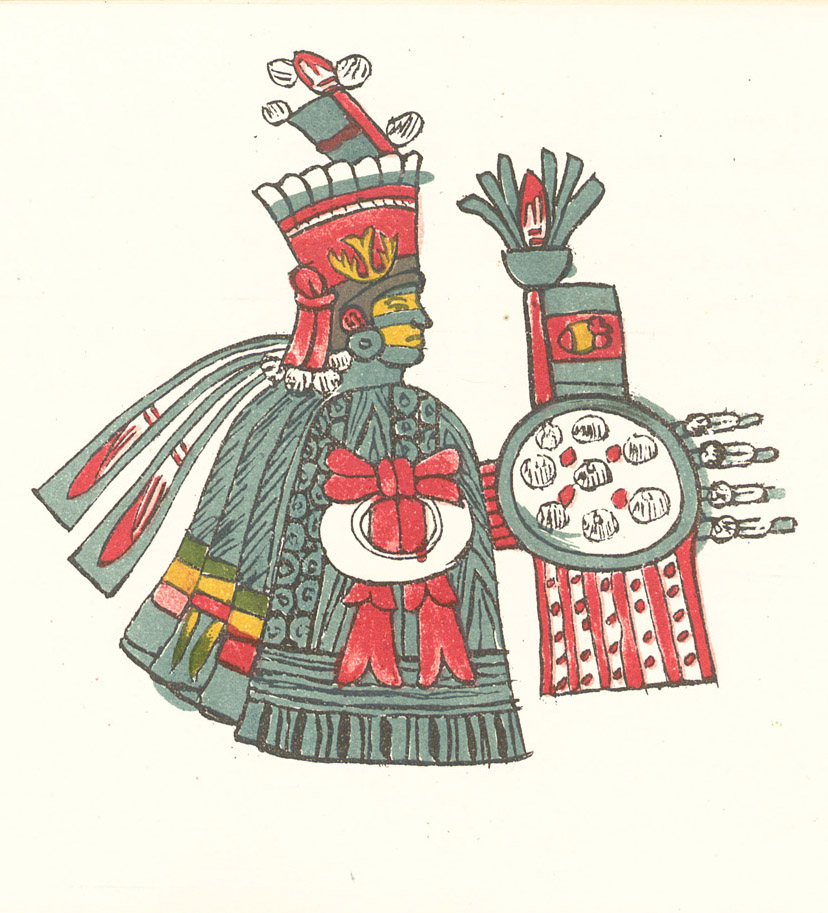
The Herb Quauhtlahuitzquilitl, Page 32 Recto of the Codex Badianus

Basic Nahuatl Pronunciation

As promised earlier,  I’m doing a quick writeup of basic Nahuatl pronunciation and spelling.  Or rather, I found a good one online that’s consistent with what the best modern dictionaries are using.  The guide below is shamelessly ripped from the Wikibooks entry that houses it, and is extended with a few notes of mine.  My thanks to the authors of this guide — Ptcamn, Icelandic Hurricane, and Jguk!  Go HERE to view the original entry on Wikibooks.  Or go HERE to have Wikibooks render a downloadable PDF of this guide (without my notes) for you.

UPDATE:  … and it appears that the guys who set up the Wikibooks entry ripped it from David K. Jordan’s Nahuatl page, and extended it with their notes.  The original is HERE, to give credit where it’s due.

Vowels

Nahuatl has four short vowels: a, e, i, and o. The vowels a, e and i sound similar to Spanish, while o can sound like either a Spanish o or a u. Unlike in English, where cuter and cutter have different vowels, the vowels of Nahuatl don’t change depending on what follows them.

Each vowel also has a long form, marked by a line or macron over the vowel: ā, ē, ī, ō. They have the same sound as the short vowels, but are simply held longer. [Cehualli’s note — these macrons are often omitted in actual texts]

Consonants

Nahuatl ch, m, n, p, t, and y are pronounced like English.

As in English, c represents an s-sound when followed by e or i, but a k-sound elsewhere.

Cu is pronounced kw, like in Spanish, or like English qu. Its inverse, uc, is the same sound at the end of a syllable.

Hu is pronounced like English w. Like cu, it is reversed at the end of a syllable, so auh sounds like ow, and iuh sounds like eww.

H alone, when not part of ch, hu or uh, may have represented a glottal stop, as in the Cockney pronunciation of bottle, or it may have been a sound like English h. Unlike English h, it is pronounced at the of syllables: ah isn’t simply a vowel, but a vowel followed by a consonant.

Before a vowel, l is the same as English or Spanish l. Before a consonant or at the end of a word, however, it is neither dark like English l in full, nor clear like Spanish l. It is a voiceless sound, like Welsh ll. This isn’t important to understanding, though, and it can be pronounced like an English l without introducing confusion.

Double ll is simply l, held longer. It isn’t a palatal sound like in Spanish, or a single l like in English.

Qu is used to represent the k-sound before e and i, like in Spanish. It isn’t pronounced “kw” as in English.

X is pronounced like English sh.

Tl is pronounced like t with the tongue held in a postion for l [Cehualli’s note — when this comes at the very end of a word, the l is very quiet, almost a whisper.  Not pronounced “tul” as one might think!]

Tz is pronounced like German z, or like English ts except that the t is pronounced even at the start of words — not like tsar or tsunami, where the t is silent.  [Cehualli’s note — like the ts in “kits,” in other words.]

Z is pronounced like English s.

Stress

Stress regularly falls on the second last syllable of a word.

Spelling

The spelling used here is a modern standardized system, in order to represent all the sounds of Nahuatl consistently. The spelling used in the original manuscripts did not always represent Nahuatl pronunciation accurately. In particular, vowel length and h were usually omitted.  [Cehualli’s note — in a rare few manuscripts, like Carochi, you may see diacritics and other odd marks.  Very rare, not something to worry about in general.]

Spelling & Pronunciation of Classical Nahuatl Words

Because the spelling of Nahuatl was originally based on spelling conventions in Spanish, Nahuatl texts are generally “pronounced like Spanish,” with the following exceptions and points to note:

  • Words are stressed on the second-to-the-last vowel (excluding U) regardless of final consonants
  • X is pronounced like English SH.
  • LL is pronounced like a long L (not as in Spanish).
  • TL counts as a single consonant, never as a full syllable.
  • U does not occur as an independent vowel. The only Nahuatl vowels are A, E, I, and O, although each of them can be long or short.
  • CU and UC are both pronounced KW.
  • HU and UH are both pronounced W.
  • H without an adjacent U represents a “silent” glottal stop (as in go_over); in modern Nahuatl it sometimes has a sound similar to an English H and may have had that value in some dialects of Classical Nahuatl as well. (For an English speaker, pronouncing the H like an English H is not really wrong and has the advantage that it helps one remember that it is there.)
  • C before E or I is pronounced like English S. (The letter S is not used in Classical Nahuatl.)
  • Z is pronounced like English S. (The letter S is not used in Classical Nahuatl.)

However over the centuries there has been considerable instability in the spelling of Nahuatl. Some common variations:

  • The letters U and O may be used interchangeably to represent the sound of O.
  • The letter U alone may be used instead of UH or HU to represent the sound of W.(At the time of the Conquest, the written letters V and U were usually reversed in Spanish from their modern values, so U indeed had the value of a modern English W.)
  • The letter H representing the glottal stop may or may not be written.
  • Vowel length may or may not be marked.
  • The consonant Y may be written with the letter I.
  • The vowel I may be written with the letter Y.
  • The letter Ç may be used in place of Z to represent the sound of S.

In this century American linguists working with modern Nahuatl have sometimes preferred spellings that look less Spanish (and “coincidentally” more English). Thus:

  • W may be used in place of HU or UH for the sound of W.
  • K may be used in place of QU/C for the sound of K.
  • S may be used in place of Z/C for the sound of S.  [Cehualli’s note — Ç is also in this category.]

In some cases weird letters, available on no keyboard and included in very few type fonts, are used for TL, CH, CU/UC, and TZ to stress that these are single consonants, not compounds.*

Tigre Rope Fighting In Zitlala

Following up on last week’s post discussing the survival of Precolumbian gladiatorial combat in honor of Tlaloc in Mexico, I’ve got a video today that actually shows part of a Tigre whip match at Zitlala.  Now that this activity has come to my attention, it’s something I’ll be watching for videos of in addition to Danza Azteca.  It’s interesting getting to actually see the story behind the jaguar mask and contemplate the deeper meaning behind the fighting.

Courtesy link to ArchaeologyTV’s page on YouTube for this Tigre combat video.

In case you’re wondering, the special rope club used by Tigre fighters in Zitlala are called cuertas.  The modern cuerta itself is actually a “friendlier” version of heavier rawhide and stone clubs used previously, which in turn were descended from stone and shell clubs used when the battles may well have been lethal.  For obvious reasons, the present-day trend has been away from fatal contests, though the underlying meaning of giving of oneself to Tlaloc for a plentiful harvest endures today among those who remember.

Tlaloc In Zitlala

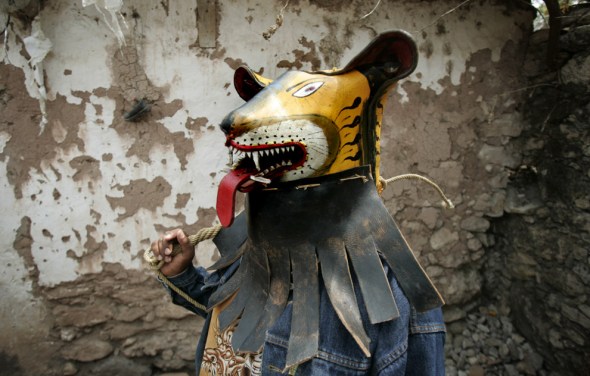
Came across an interesting photograph recently that’s quite interesting, as it shows an aspect of a Pre-Columbian ceremony still surviving today in Zitlala, Mexico.

Tigre Fighter With Whip & Jaguar Mask. Copyright 2008 by the Associate Press/Eduardo Verdugo.  Used without permission.

Tigre Fighter With Whip & Jaguar Mask. Copyright 2008 by the Associated Press/Eduardo Verdugo. Used without permission.

Link to original photograph source.

Original Caption:

“A man dressed as a tiger carries a small whip made from rope in Zitlala, Guerrero state, Mexico, Monday, May 5, 2008. Every year, inhabitants of this town participate in a violent ceremony to ask for a good harvest and plenty of rain, at the end of the ceremony men battle each other with their whips while wearing tiger masks and costumess. (AP Photo/Eduardo Verdugo)” [Cehualli’s note — “tiger” is a common mistranslation of “tigre,” when the context makes it apparent a jaguar or other large cat is meant.]

Now…there’s a lot more going on here that the photographer doesn’t get into in his note.  Specifically, that this is a modern survival of traditional indigenous religious practices.

Why do I think this?  Let me explain.

There’s a certain ancient god of rain in Mesoamerica who has traditionally been associated with jaguars… and that’s Tlaloc.  In the codices, if you look carefully you can see that He’s always depicted with long, fearsome jaguar fangs.  The growl of the jaguar resembles the rolling of distant thunder, and the dangerous power of such an apex predator fits the moody, explosive-tempered Storm Lord quite nicely.  The jaguar as a symbol of Tlaloc is a very ancient tradition that appears across the whole of Central America, whether the god is being called Tlaloc, Cucijo, Dzahui, or Chaac.

The whip-club is another hint.  Flogging has been done as part of rain ceremonies for Tlaloc for centuries (I wouldn’t be surprised if it’s symbolic of lightning).  Additionally, though the photographer didn’t mention this, one knows what happens when people strike each other hard with whips like the one the man in the photo is shown carrying — you bleed.  A lot.

In Prehispanic Mexico, one of the important rituals for Xipe Totec, the Flayed Lord, god of spring and new growth, is called “striping.”  Striping involved shooting the sacrificial victim with arrows for the purpose of causing his blood to drip and splash on the dry earth below, symbolizing rain that would bring a good harvest.  Similar rituals specifically devoted to Tlaloc were also done, and I wouldn’t be surprised if the gladiatorial combat done for Xipe Totec had the same basic idea in mind, sprinkling blood over the ground done to call the rain.

The next part is due to my good friend Shock and her impressive knack for research.  While we were discussing this photo, Shock directed me to an excellent article about this phenomenon known as “Tigre Boxing” that still exists all throughout Mexico today.  It even discusses this specific form of battling with whips in Zitlala that this photograph is of.  I highly recommend checking it out, as it’s loaded with more information about the surviving practice of gladiatorial combat for rain, complete with many excellent photos of the jaguar masks, sculptures, and even videos of the combat!

Click HERE to go to the Tigre Boxing article.

Flower Songs of Nezahualcoyotl

A little poetry today for your contemplation and enjoyment.   I dug up John Curl’s translation of several songs commonly attributed to Nezahualcoyotl over on FAMSI.  The translations are quite nice, though I’d ignore his discussion about Nezahualcoyotl and Texcocan religion, as he seems to have bought into the myth that this ruler was a King David-esque poet, monotheist (!!), and crusader against sacrifice.  This spurious idea got its birth right after the Conquest, and has been incredibly difficult to get rid of since.  If you want to read a systematic study of this misrepresentation, its origins, and its repercussions on Mesoamerican studies since, I recommend checking out Jongsoo Lee’s The Allure of Nezahualcoyotl: Pre-Hispanic Religion, Politics, and Nahua Poetics. Dr. Lee thoroughly dismantles this idea and provides a wealth of information about Colonial distortions of Nahua religion and poetry, particularly where it intersects the “Nezahualcoyotl as pseudo-Christian” myth.

Bad history aside though, Curl’s actual translations are enjoyable, and I invite you to check those out.

Click HERE to read John Curl’s translations of Nahua poetry.

Nezahualcoyotl, From The Codex Ixtlilxochitl

Nezahualcoyotl, From The Codex Ixtlilxochitl

New Nahuatl Language Links

I’ve added a new Links section over on the righthand side of the page, called Nahuatl Language.  That section is where I’m linking material around the Net that relates to learning Nahuatl, particularly Classical Nahuatl (the language as it was a few hundred years ago).  This stuff is always handy for reference, and to get your feet wet if you’re interested in learning how to read some of the primary sources that were written down in that tongue after the Conquest.

These links relate to reading Nahuatl written alphabetically, not reading the glyphs/pictographs that were used in the Codices prior to the Spanish invasion.  I’m looking for material online that teaches a bit about the glyphs, though, and will link what I find.

Finally, the links in there now are in a mix of languages.  Molina’s classic textbook and dictionary are antique Spanish and Nahuatl; I included them for those who can read old Spanish (not me!) and due to their foundational significance in the study of the language.  The html version of Renee Simeon’s 1885 dictionary is Nahuatl to French, but I would expect the numerous free online translators could handle the short snippets of relatively-recent French without much trouble.

For my English-language audience, the Nahuatl Learning Environment is available in English (it’s also available in Spanish).  Just log in with the ID and password noted in the link title (repeated in the tooltip if you hover your mouse cursor over it), and you’re good to go — there’s no registration or anything like that.  Finally, the Freelang Nahuatl dictionary is a Nahuatl-English dictionary, and can be downloaded for offline use, or used via the web.  Handy and free!

I’ll do a post sometime soon on basic pronunciation to go with all these links.  I’ve seen the very formal charts on pronunciation that use the technical symbols and whatnot, but frankly I can’t read them, and I don’t know many who can.  If you have a copy of Frances Kartunnen’s Analytical Dictionary of Nahuatl, I find her notes on pronunciation to be the most helpful I’ve come across.

Anyway, enjoy, and I’ll add more to this section as I find it.

Operation Circle Care

In the spirit of yesterday’s post on charity, I’m highlighting a Pagan charity that addresses an issue dear to my heart.  Namely, it’s Circle Sanctuary’s Operation Circle Care, and they put together care packages for Pagan troops in the military.  This is a moving cause to me as many of my relatives have been in the military, the most recent of which is my younger brother.  (In case you’re wondering, he finished 2 tours of duty in Iraq with honor, and has since joined a private security contracting firm and is back in Baghdad under their banner.  He’s doing all right, is healthy and in one piece.)  Plus, we all know Huitzilopochtli has a special place in His heart for soldiers.

I strongly encourage you to stop by Circle Sanctuary’s Operation Circle Care page and check it out.  They welcome a wide varierty of forms of support for the troops, from money and goods to prayers and rituals.

Click to visit Circle Sanctuary’s Operation Circle Care page.

Charity

“Respect the unfortunate old men, the unfortunate women, the miserable, the poor; take pity upon them. Give one somewhere perchance a poor, worn, breech clout, a miserable netted maguey cape; tie, wrap them about him; give him something to drink. For he is the representative of the master, our lord. For this thou shalt be given life on earth…”

The Florentine Codex, Book 9, Chapter 12, p.56-57

(Dibble & Anderson translation, copyright University of Utah, used without permission)

The above lines are from a speech given by the elder merchants to a younger one during the festival month of Panquetzaliztli.  I’ve chosen to share this segment of one of the huehuetlatolli, or moral speeches as part of a discussion on Aztec virtues and ethics.  This article will focus on the virtue of charity, with an analysis of the speech above used to sound out what the Mexica thought about this moral precept.

I’ve decided to bring up charity at this time for several reasons.  The first and most obvious —  information on traditional ethics and its intersection with religion is of eminently practical use.  Second I live in the USA, so the majority of the population here is getting ready to celebrate Christmas, and the issue of charitable giving is at the forefront.  The final reason ties into the second — with religion in the air at the moment, I’ve been seeing a lot of bigotry and outright slander of non-Christian ethics lately. I’m sick of it, and decided it’s time for me to respond to that foolishness by setting the record straight.  So, let’s begin!

Context

The context of the lines I quoted from the Florentine Codex is in the veintana of Panquetzaliztli.  A young merchant has thrown a banquet for his elders, complete with gifts of food, tobacco, and clothing.  At one point he explains to his guests why he’s done this — he’s received the wealth of “the master, the lord,” as the fruits of his labor.  He acknowledges this wealth is actually a blessing of the gods, specifically Huitzilopochtli.  (Page 55 makes it clear that “the master, the lord” here is Huitzilopochtli, and not Tezcatlipoca, despite the similarity of the title to some commonly used for the Smoking Mirror.)  Because he realizes this wealth is a blessing, he wishes to seek the presence of Huitzilopochtli.

Seeking The Face Of God: Charity As A Duty

The young merchant shows the reader that one way to find this Teotl’s presence is through the wisdom of his elders.  He pleads with them to “reveal the secrets of the master, our lord, the portent, Huitzilopochtli” (Sahagun, 55).  His elders proceed to unveil these secrets — they are actually various ethical precepts, in addition to the ritual banquets specifically prepared by the merchants to honor the god and share their prosperity.  Particularly emphasized among these precepts is charity.

The language in this speech is especially interesting, given how closely it parallels one of the most beautiful parables in the Gospel of Matthew, Matthew 25:34-46.  These are the verses where Jesus tells his disciples “For I was hungry and you gave me something to eat, I was thirsty and you gave me something to drink, I was a stranger and you invited me in, I needed clothes and you clothed me, I was sick and you looked after me, I was in prison and you came to visit me.”

In these huehuetlatolli lines, we see a striking parallel, right down to the injunction to give the needy food, clothing, and drink, and the revelation that the poor are actually humble representatives of the god.  In both, the reward of loving charity is life.  Finally, Matthew indicates that the reason for this duty is because the good things being given were first granted to the donor as divine blessings.  A blessing carries with it a responsibility.

I find a similar responsibility in the words of the young merchant and his elders in the Florentine Codex.  On page 55, the youth acknowledges his wealth is really that of Huitzilopochtli, and the god is described as “showing” the riches to him.  This is a common way of describing prosperity — it’s not truly self-earned by the person, but is actually on loan from the gods, a blessing.  The young merchant expresses a desire to use it well, to return a portion of it as offerings, and the elders indicate that the right course of action is to share it with the poor as well.  It doesn’t take much effort to realize that the same kind of responsibility attaches to the gifts Huitzilopochtli gives as well as those Jesus speaks of in the book of Matthew.  In a nutshell, the god says to the wise man, “I give so that you shall give.”  It’s only the foolish man who disobeys.

Jesus’ parable continues to indicate that those who shirk their duty of charity insult the deity and will be punished.  The Aztecs held similar views.  If because the merchant gives generously he will be “given life on earth,” there’s clearly an unspoken corollary of if he doesn’t, he’ll lose his life.  Though left unsaid here, in Book 6 of the Florentine Codex, it’s made explicit.  In some of the speeches there, the elders and priests admonish a newly-elected ruler to humility, not to be proud of the wealth and status he’s received.  This wealth and status really belongs to Tezcatlipoca, and if he offends the god, Tezcatlipoca will surely take it back and destroy him for his arrogance.  Huitzilopochtli seems to have a similar sense of propriety.

Christian Influence?

Due to the similarities between this passage and the one in Matthew, some might think that it’s a piece of Christian doctrine absorbed by the Aztecs after the Conquest from the Spanish friars.  “Surely these heathens couldn’t have such good morals and a concern for the poor!” people like that might think to themselves, convinced in their ignorance that only Christianity is a source of loving ethics.  To them, I say you’re dead wrong, and should repent of your arrogance.

Though I’m not a professional anthropologist, I doubt this passage is an example of Post-Conquest syncretism for two main reasons.  One, Sahagun is generally one of the more reliable Post-Conquest sources, and Book 9 in particular contains detailed ritual information that would’ve been prime candidates for being censored, yet he didn’t.  Not censoring such explicitly pagan religious practices makes it harder for me to believe that this one has been tampered with.

Two, the passage identifies Huitzilopochtli as the key player involved in these moral precepts.  Why is that so significant to me?  It’s because Huitzilopochtli has to be one of the most intensely villified and suppressed of the Teteo after the Conquest.  Elizabeth Hill Boone in her monograph, Incarnations of the Aztec Supernatural: The Image of Huitzilopochtli in Mexico and Europe , discusses the unrelentingly negative portrayal of Him by the Spaniards and how they worked damn hard to try to erase Him from the memory of His people.  Not too surprising, for if you want to subdue a proud, martial people, you’re going to want to eliminate their tutelary god, the high god that exhorts them to feats of heroic strength and military prowess.

Thus, Sahagun had every incentive to scrub this passage for its positive portrayal of this maligned deity, and I can’t imagine he could’ve missed the similarity to Matthew 25, something at least some of his bosses would surely have found to be blasphemous.  (I.e., the old “the Devil counterfeiting Christianity to deceive” argument that dates back to Justin Martyr, if I recall correctly.)  Yet… he didn’t do this, strengthening my thought that this is a genuine Precolumbian practice.

Those are just a couple of reasons why I trust the passage is genuine, without taking a lengthy detour into textual criticism that’s better left to the experts to write.

Practical Implications

So, we’ve established that traditional Aztec morality holds up charity as a noble practice, and has a religious basis underlying this ethical precept.  This has implications that are immediate and plain.  Playing Captain Obvious, we’re clearly to be generous to those in need, not to be greedy with the gifts we’ve been given by the gods, but to share them with others.  I’d been somewhat working under the concept before that the gods weren’t necessarily moral lawgivers, but, having read this very blunt chapter linking Huitzilopochtli with charity trashes that idea pretty thoroughly.  I’ll admit it, I stand corrected on this one.  Whoever you guys were who were recorded by Sahagun, 450 years later this American thanks you for the clarification, your counsel is still educating people.  I’ll have to chew some things over in my mind some more.


Leaving Coatepec

This is the next part of the Tenochca founding epic, taking place at about the same time as the “First Steps From Aztlan” part of the story.  This part tells about Huitzilopochtli’s tearful departure from His mother, Coatlicue, as He sets out from Coatepec to lead the Mexica south.

This one is a little different from the other sub-stories in the saga, as it doesn’t come from the more usual sources of myth.  I know of this scene from an apparently Post-Conquest story that tries to shed some light on why the defense of the Aztec homelands failed, and why it seemed the gods abandoned them, especially their trusted patron.  In that legend, some of Motecuhzoma’s seers travel to Coatepec to bring Coatlicue a gift, and She speaks of Her son’s departure, and His prophesied return home to Her.  I’ve decided to break out Her reference to this event and tell it here, and save the other story for later.

Leaving Coatepec

As told by Cehualli

Some time after the great battle against Coyolxauhqui and the Centzon Huitznahua, Coatlicue had begun to notice a change in Her son.  While once He had been content to stay close to Her side, now He had taken to wandering farther and farther away.  Sometimes She would notice Him gazing far to the south, the Land of Thorns, with an intensity that bespoke of great plans and ambition.

One day, in the Year of the Flint Knife, She watched Him staring off longingly at some distant southern land again, and She knew in Her heart that Her son was planning to leave.  “My beloved son…come to Your mother,” She said quietly.

In a moment, Huitzilopochtli had reached Her side with haste.  “What troubles You, Mother?”

“Son… I know Your heart is already in some place far to the south, not here at Coatepec.  Where do You plan to go?” She asked.

He paused a moment, glancing back to the left of the Sun.  “As usual, nothing escapes Your wisdom, my dear Mother.  I need to test My strength, to go on a grand adventure with My people, the Mexica.  I have seen it that We will conquer much and found a mighty empire for the glory of the Teteo.  How can I resist such an exciting prospect?” He poured out His heart with eagerness, already looking forward to the thrill the future promised.

Coatlicue smiled at the irrepressible spirit of Her son, yet this smile was tinged with sadness at the knowledge of their impending parting.  “Clearly, Your mind is made up to go, and go quickly.  I won’t stop You from going to meet Your bright destiny and seeking adventure.” Huitzilopochtli’s eyes lit up like the dawning sun.  Coatlicue went to a reed chest and pulled out a small bundle, pressing it into Her son’s hands.  “I have a parting gift for You.”

Huitzilopochtli unwrapped it partially, finding two pairs of new sandals within.  “One pair is for Your journey south, to the place in Your dreams, Tenochtitlan,” Coatlicue said.

“Thank you, Mother!” He replied, taking off His old sandals and putting on the new pair.  “But what’s the second set for?”

“They are for Your journey home,” She said softly.  “I’ve seen how the adventure ends, My son.  You will indeed conquer much, and achieve fame and wealth beyond measure.  But We both know that nothing lasts forever on Earth, not the shining quetzal feathers that will one day fade, nor the glittering gold that will turn to dust.  The same will be true of Your beautiful empire.  As You take land on Your way south, in the reverse order will You lose it, until at last the day comes when Your people will fall, and You will find Your strength exhausted.   When that dark day comes and you must don those sandals and bid the Mexica farewell, know that I will be waiting for you at the door with open arms to welcome You home.”

Huitzilopochtli nodded gravely.  “Thank You for Your wisdom and counsel, Mother.  Your words are more precious to Me than any of the riches I’ll capture.  I’ll keep them in My heart the whole time I’m away at war, until the day We meet again.”

With that, He gathered up His shield and Xiuhcoatl, His flaming serpent-spear, and tucked the second set of sandals into His bundle for the trip.  He embraced His mother one last time, and with a mixture of sadness and eagerness to see what the future had in store for Him, raced away from Coatepec.  He would not see Snake Mountain again for over two hundred years.

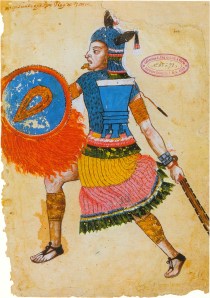
Huitzilopochtli, Page 43 Recto of the Codex Magliabecchiano

Huitzilopochtli, Page 43 Recto of the Codex Magliabecchiano