Mesoamerican Culture, History, and Religion

Latest

The Anonymous Conqueror’s Narrative

Funny how things tend to come in clusters. One day I find the full text of Soustelle’s The Daily Life of the Aztecs, today I find a complete English translation of the Anonymous Conqueror’s Narrative of Some Things of New Spain and of the Great City of Temestitan, México. (In case you’re wondering, Temestitan is an old Spanish corruption of Tenochtitlan.)

This is one of the more obscure Conquest-era histories, allegedly written by one of the Conquistadores under Cortes. We’ve never definitively identified who the author was, but the book seems to be generally accepted as a genuinely early document. The book is an account of the Conquest itself and a concise overview of life in Tenochtitlan at the time, from a recently-arrived European perspective. As usual, such works have to be read carefully, with an awareness of problems of reliability, bias, and cultural misunderstandings/ignorance. With those caveats aside, however, early material like this can still be quite useful.

Go HERE to read Marshall H. Saville’s 1917 English translation of the Anonymous Conqueror’s Narrative of Some Things of New Spain and of the Great City of Temestitan, México, edited by Alec Christensen and kindly hosted on FAMSI.

I have also updated the First Contact & Conquest Era History page on this site with a permanent link to this work.

Now, if you will excuse me, I’m going to go crash before I face-plant on my keyboard, as I’ve been awake for almost 24 hours straight now, 13 of which were spent at work… Just had to share this random discovery before catching some sleep.

Soustelle’s Daily Life Of The Aztecs

I was doing some digging online today, and had quite a stroke of good luck — I found a complete copy of Jacques Soustelle’s classic The Daily Life of the Aztecs online! The English edition of the entire book is available to read for free on Questia. Soustelle was a famous French anthropologist who specialized in studying the Aztecs before the Conquest, one of the bright lights in Mesoamerican studies of the mid 20th Century. His Daily Life of the Aztecs is one of his best-known works on this subject, covering a wide variety of details of Mexica life in great Tenochtitlan, ranging from architecture to agriculture, religion, economics, and the conduct of war. Though somewhat dated (written in 1962), most of the information in this book still remains quite useful, and his respectful, non-sensationalistic tone is refreshing. As it predates the rediscovery of the Templo Mayor (Huey Teocalli) in the 1970’s, it sadly doesn’t include much on that famous structure. Still, I strongly recommend giving it a read, as it remains one of the better general histories and anthropological overviews of life in Precolumbian Mexico.

Go HERE to read The Daily Life of the Aztecs in full!

Incidentally, I have now activated the Pre-Conquest History page in the History section of this blog’s static pages and placed an additional permanent link to this book there.

Aztecs At The British Museum

In the spirit of the aphorism “a picture is worth a thousand words,” I recommend stopping by the British Museum’s Aztec collection online. They have available 27 photographs (well, 26 if you ignore the crystal skull that’s been proven to be a hoax) of beautiful Aztec and Mixtec artifacts. Among them are statues of Quetzalcoatl, Tezcatlipoca, Mictlantecuhtli, Tlazolteotl, Tlaloc, Xochipilli, and Xipe Totec, as well as a rare mosaic ceremonial shield, a turquoise serpent pectoral, and a sacrificial knife. The images are thought-provoking and intense, as these objects speak wordlessly the vision of the Nahua peoples without Colonial censorship.

Click HERE to visit the British Museum’s Aztec Highlights.

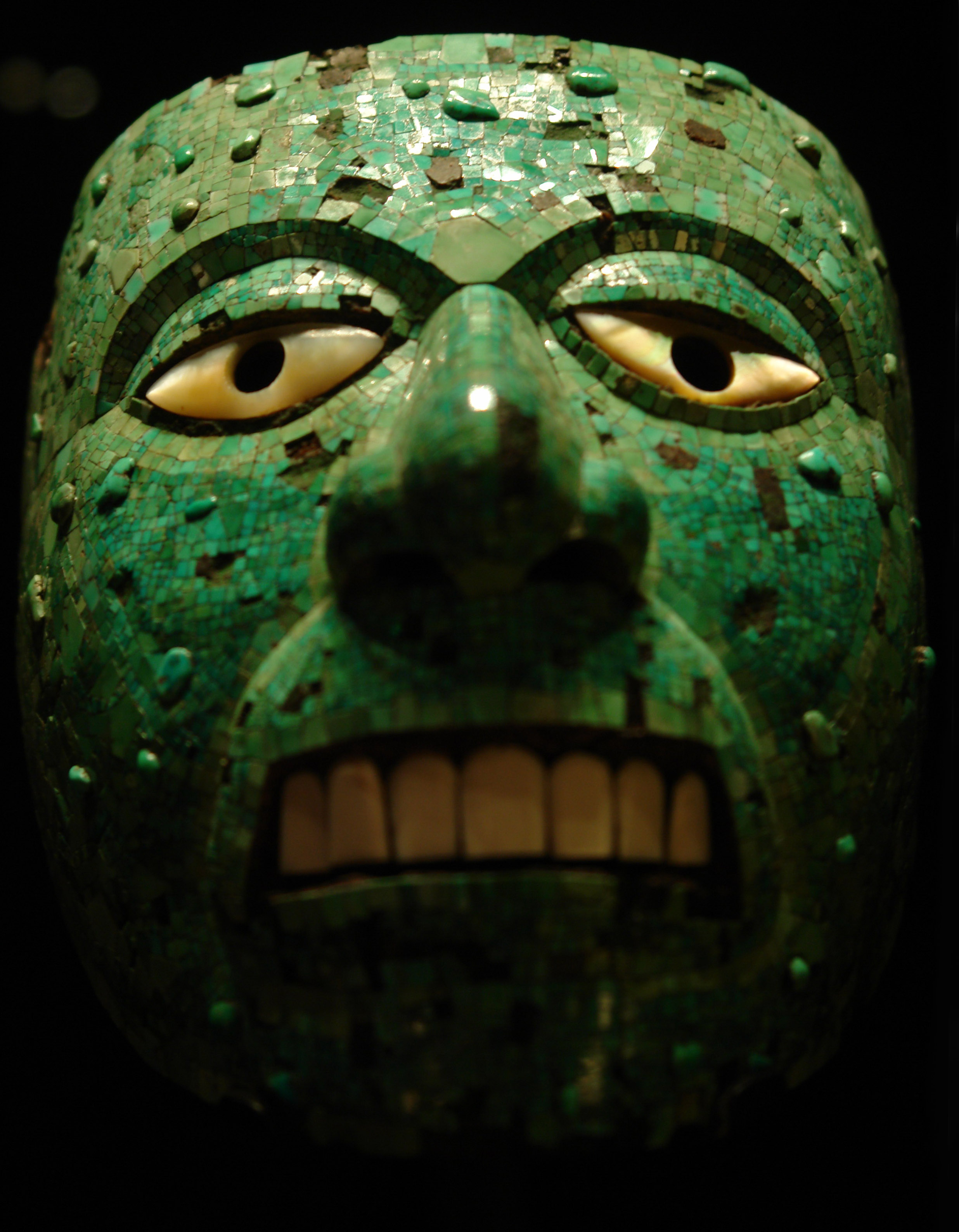
As a bonus, I located an excellent photograph of a jade mask of Xiuhtecuhtli, God of Time and Fire, which is a part of the British Museum’s collection but is not on their website. Thank you Z-m-k for putting your fine photography skills to work on this worthy subject material and for your kindness in sharing it under the Creative Commons Attribution Share-Alike 2.5 License.

Jade Mask of Xiuhtecuhtli

Jade Mask of Xiuhtecuhtli

Identity Of The Fire Drill Constellation

Good news! My dear friend Shock answered my plea for help regarding the identity of the Fire Drill constellation that was discussed in my article on greeting the dusk. She’s studied the scholarship on Mesoamerican archaeoastronomy extensively and kindly popped in to shed some light on this issue. This is what she had to say regarding the identity of the Fire Drill:

“Anyway… About the fire drill constellation. It’s Orion’s Belt, clear as day if you look at the evidence. The Pleiades couldn’t possibly be it. It’s a seven/six star cluster within Taurus and used as a reference point for the Fire Drill in the primary source material. Taurus itself couldn’t be it for these same reasons and the fact that its other noticeable stars aren’t in a straight line. The Cygnus idea makes little to no sense considering that Sahagun clearly states in book 7 of the Florentine that the constellation is near the Pleiades. Cygnus is NOWHERE near the Pleiades in the night’s sky. In book 7, look up two parts. First, the fire drill part in Nahuatl and then Sahagun’s commentary in Spanish under Castor and Pollux. Several things are clear; the Fire Drill needs to be by Gemnini and it needs to be by Taurus. It also has to be a straight line of three bright stars. The straightness is reiterated in the Nahuatl text numerous times. And what’s right by both of these, with three bright stars? Orion’s belt. And then you have the comparative ethnography stuff from FAMSI, plus there’s more stuff similar to that which is closer to Mesoamerica.”

So, it does look like the best candidate for the Fire Drill constellation is the stars of Orion’s Belt!

Also, apparently the guy who favors the Northern Cross as the Fire Drill is a poor-quality “scholar” associated with the atrocious “mayalords.org” site, so I’d recommend ignoring him beyond the value of knowing what the crap arguments are out there.

Thanks Shock!

Incidentally, I have updated my other post with this important information for convenience and clarity.

Greeting The Dusk

The Starry Night Sky

The Starry Night Sky

“Yohualtecuhtli, the Lord of the Night, Yacahuitzli, has arrived! How will his labor go? How will the night pass and the dawn come?”

Following up on my earlier article on how the priests greeted the dawn, above is my rendition of the traditional prayer saluting the dusk. It is a modernized composite of the two variants recorded by Sahagun and Tezozomoc. (To read Dr. Seler’s translation of the Tezozomoc version, click HERE and search within the book for youaltecutli. The only hit is on page 357, containing the prayer in question.)

This prayer was traditionally offered around sundown, as a particular constellation called mamalhuaztli, the Fire Drill, rose from the east into the darkening sky. It was accompanied by the offering of incense, being another one of the nine times a day the priests would offer copal to the Teteo.

You may be wondering exactly what constellation mamalhuaztli is, as its rise was the traditional signal to perform this rite. The bad news is. . . we’re not sure. Partially because the records suck, partially because the constellations have drifted in the sky over the past millennium or so. We have enough information to know that this constellation was in the vicinity of the Pleiades, and apparently some scholars think the Fire Drill was three stars that are part of them. However, the stars in Orion’s belt are another popular theory, and at least one guy seems to consider the Northern Cross a candidate, though his credentials are suspect at best. The link above to the original language of the prayer includes some of Seler’s deductions regarding the identity of this constellation, though sadly the whole thing isn’t available. Go HERE for a very brief discussion on the Aztlan mailing list hosted by FAMSI regarding the Orion vs. Northern Cross debate if you’re curious.

Due to this uncertainty, I’d advise taking the obvious route of observing this prayer either at sunset or right at full dark. It’s not perfect, but it should be in the ballpark I’d think, and archaeoastronomy isn’t my strength. So, good enough for me, and it seems a reasonable alternative for modern practice in the face of a gap in our knowledge. However, if anyone does have a good background in this branch of astronomy and can help out, I’d be interested in hearing what you have to say about the identity of the Fire Drill constellation.

UPDATE 10/2/08:

Well, my dear friend Shock answered my plea for archaeoastronomy help on this issue! This subject is one that’s close to her heart, and she’s studied the scholarship on this area extensively. This is what she had to say regarding the identity of the Fire Drill:

“Anyway… About the fire drill constellation. It’s Orion’s Belt, clear as day if you look at the evidence. The Pleiades couldn’t possibly be it. It’s a seven/six star cluster within Taurus and used as a reference point for the Fire Drill in the primary source material. Taurus itself couldn’t be it for these same reasons and the fact that its other noticeable stars aren’t in a straight line. The Cygnus idea makes little to no sense considering that Sahagun clearly states in book 7 of the Florentine that the constellation is near the Pleiades. Cygnus is NOWHERE near the Pleiades in the night’s sky. In book 7, look up two parts. First, the fire drill part in Nahuatl and then Sahagun’s commentary in Spanish under Castor and Pollux. Several things are clear; the Fire Drill needs to be by Gemnini and it needs to be by Taurus. It also has to be a straight line of three bright stars. The straightness is reiterated in the Nahuatl text numerous times. And what’s right by both of these, with three bright stars? Orion’s belt. And then you have the comparative ethnography stuff from FAMSI, plus there’s more stuff similar to that which is closer to Mesoamerica.”

So, it does look like the best candidate for the Fire Drill constellation is the stars of Orion’s Belt!

Also, I’ve been informed that the guy who favors the Northern Cross as the Fire Drill is a third-rate “scholar” connected to the godawful “Mayalords” site, so I’d recommend ignoring him beyond the value of knowing what the crap arguments are out there.

Thanks Shock!

If you’re particularly interested in this subject, I recommend watching the Comments on this post for more.

Aztec Prayers & Poems Collected By Alarcon

I came across a lovely little hoard of traditional Aztec poems, prayers, and songs the other night. These were originally recored in Ruiz de Alarcon’s 1629 work, Tratado de las supersticiones y costumbres gentílicas que oy viven entre los indios naturales desta Nueva Espana, commonly referred to as “Treatise on Heathen Superstitions” for short in English. For example, he’s posted prayers for safe travel, for love, and even a myth in song about Xochiquetzal and the Scorpion. Professor Joseph J. Fries of Pacific Lutheran University is the person who has generously posted these precious literary treasures, and he includes a bit of commentary as well. Thank you, Dr. Fries!

Click HERE to read some Aztec poems!

The Goddess Xochiquetzal

Xochiquetzal, Goddess of the Arts

Greeting The Dawn

The Sun Disk

The Sun Disk

“The Sun has come, has risen, the Shining One. How will He fare today? What will He do? Maybe disaster will strike us, His people. O Lord, go and do your noble duty! Bring light to Earth’s Surface!”

Above is my version of one of the traditional Aztec prayers to greet the sun, modeled upon the one recited each morning. (To read the original that inspired this, go HERE and type Tonametl in the “Search in this Book” field. A professional translation of the source prayer is the only hit on page 50, so you can’t miss it.)

Traditionally, a prayer like this was offered right at sunrise, as the Sun, Tonatiuh (literally, “He Goes Forth Shining”), climbed into the sky. It was a daily duty of the priests, and they accompanied their prayer with the beheading of quail, burning copal incense, and possibly autosacrifical bloodletting as well. While the daily offering of quail was generally reserved for the priests and not the general populace, prayer, incense, and autosacrifice were things accessible to all.

The basic structure is simple, and some of its features appear in the longer, more elaborate festival prayers. It has an invocation and a recitation of the god’s name(s), and parallel repetition of phrases. The repetition is a common feature of what was called “lordly speech” in Imperial times, and was a formal style of rhetoric used by nobles and by people addressing the aristocracy. As the Teteo are depicted as the nobility over humans, the same type of formal language is used in prayers addressing them, as all humans would be commoners or macehuales to Them. These techniques combine to show the respect the worshipper has for the gods.

The second half of the prayer consists of contemplation of the future, including the realization that our world is an uncertain, unstable place, and our fortunes could reverse at any time. I wouldn’t be surprised in this context if it is not only a statement of the fragility of mankind, but a subtle plea to Tonatiuh to not be slack in His duties of warming and lighting Tlalticpac (Earth’s Surface). Finally, the prayer closes with a double exhortation to the Teotl to shine with vigor upon the world, the petitioner literally cheering the god on.

If you wish to become more familiar with how the Aztecs composed their prayers and hymns, I recommend visiting my Hymns & Prayers section on the Sacred Texts section of this blog.

Maquahuitl

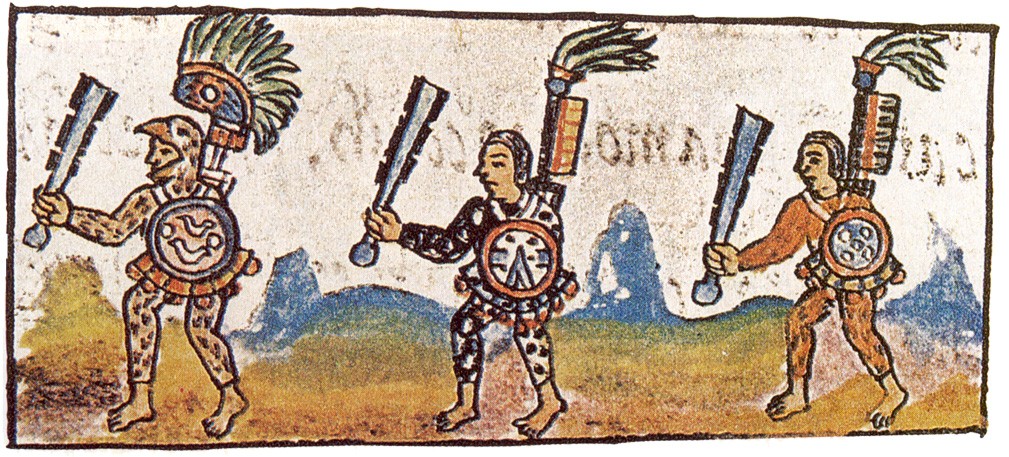
A quick update today — I came across a link to an interesting little website devoted to the study of the Aztec sword-club, the macuahuitl (also spelled maquahuitl). They even have a new forum for people to discuss traditional Mesoamerican weapons. Cool. Click to visit Maquahuitl, and tell ’em Cehualli sent you. <g>

Aztec Warriors With Macuahuitl

Library Acquisition: The Codex Mendoza & More

Wow, it’s been a while. Sorry about that. The stuff I’ve been trying to write about kinda pulled a Three Stooges with a narrow door type thing, which was not helped by adding a dash of summer laziness.

Anyway, I’ve had some amazing strokes of luck lately in expanding my library. I’ve acquired a copy of the Bancroft Dialogues, a tough to find Post-Conquest Era volume of Mexica upper class speeches, greetings, and other daily life bits of talking. It’s a significant text because it’s the only early book that has full marks indicating pronunciation, so anyone who wants to learn Classical Nahuatl needs this one. It’s also interesting because it shows how the nobles spoke to their equals and superiors. As the relationship between the Aztecs and their gods was often framed as a noble/subject relationship, I believe the examples likely hint at how they spoke to the Teteo when offering worship. I’m looking for some nice examples to post that people might find interesting.

Another major acquisition has been a copy of the deluxe four-volume Anawalt & Burdan edition of The Codex Mendoza for a stupidly good price. It’s a lovely piece of printing that makes this bibliophile get excited in unhealthy ways. Bound in three quarters Morocco leather, HUGE format, and printed crisply on good alkaline paper, it’s physically well-made. And the info is delightful. There’s a full-color facsimile, a black and white facsimile with parallel text translating the Spanish commentary, and two volumes of essays about the codex and its contents. Very nice! There’s an essay on the honorific warrior uniforms that was particularly interesting and will likely provoke a post at some point. It also gave me a lot of tips on how to spot priests in the codices based on dress and body/face paint.

Lastly, the same gentleman who sold me his copy of the Mendoza just agreed to part with his Dibble & Anderson edition of the Florentine Codex to boot, for a price I never thought I’d see on that set.

The upshot of all this frenzied book-greed for my readers? If you have questions that relate to stuff that’s covered by these texts, I may be able to help. My time’s limited, but so long as it’s reasonable I can try to look something up for you.

Templo Mayor: Offering #126

Shock kindly shared the link to this story with me recently, and I thought I would highlight it here as an interesting archaeological discovery. I look forward to when they publish their full findings.

Most Important Offering in Past 30 Years Discovered in Great Temple

Presidencia de la República
go to original

Mexico City – President Felipe Calderón toured the House of the Bows and Bells of the Great Temple Archaeological Zone, where the largest, most important offerings recorded in 30 years of excavations in this zone were recently discovered…

(Click here for the full story in English)